Dr Martin Neary LVO, MA, DMus, FRCO (1940–2025)
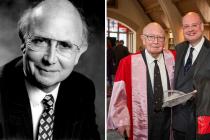
It is with great sadness that we record the death of RCO Vice President Dr Martin Neary. Dr Neary twice held the position of RCO President: 1988–90 and 1996–98.
Martin Neary became a member of the College in 1961, when he was organ scholar at Gonville and Caius College, Cambridge. He gained Associateship and Fellowship in 1962 and 1963 respectively. He first served on the College Council in 1982 and became a regular examiner. In his capacity as a Vice President, Dr Neary later returned to the Trustee Council and served from 2012 until 2020.
It was during Dr Neary’s first presidency that the College prepared for relocation from the building in South Kensington which it had occupied since 1904. By the 1980s, the Council was becoming increasingly concerned about the College’s future in Kensington Gore, because the 99-year lease (granted by the Commissioners of the Great Exhibition) was soon to expire, and the peppercorn rent of £1 per annum would probably have increased to an unacceptably large amount. The situation meant that much of Dr Neary’s presidency was spent in searching for a new home (and for a new Clerk, given the retirement of Barry Lyndon in 1990, after 25 years). Agreement on accommodation was eventually reached with St Andrew’s, Holborn for the RCO to move there on a short-term lease. This was to be the College’s home until 2003.
In his second term as President, Dr Neary was much involved in overseeing the development of St Andrew’s as a headquarters. He was assisted by Dr Lionel Dakers as Deputy President. It was a time of much change. Investigations into accommodation recommenced, a review of the examination syllabuses was undertaken, and educational and outreach work progressed in leaps and bounds. We can recall that during his first term, Dr Neary had been a supporter of the National Learn the Organ Year initiative (1990), which finds an echo today in the College’s Play the Organ Year 2025. The RCO’s events programme built in strength during his second tenure, including residential courses in Cambridge and Oxford, study days for young organists, and events around the country, some in combination with partner organisations. Towards the end of Dr Neary’s second presidency, the College held its Annual Dinner at the House of Commons (March 1998), where the host was the Right Hon. Frank Field MP, who gave the after-dinner speech.
Dr Neary’s commitment to the College and its evolution was indefatigable, and as a highly acclaimed church musician, he became a distinguished ambassadorial face of the institution. He managed to negotiate, with some judiciousness, both traditional and progressive perspectives. To conclude his last presidential speech of his first term in July 1990, and the very last presidential speech to be given at Kensington Gore, he remarked as follows: ‘We should always be grateful for the energy and foresight of our predecessors in developing the College, and I hope that they would feel, if they were alive today, that we are just as determined as they were that the College should develop its full potential and that we are also, in Sir Hubert Parry’s words, “loyal to the principles of progress while determined not to be submerged by convention”.’
Martin Neary’s musical career started as a Chapel Royal chorister (he sang at the Coronation in 1953) and he won an organ scholarship at Cambridge, where he read theology and music. As an organist, he took lessons with the great André Marchal, and in many ways this reinforced his empathy for French culture (his mother was French) and for the classical organ in general. Although very much from, and in, the sphere of Anglican organ playing and choral direction, Martin Neary as a young man broadened his horizons by pursuing a conducting scholarship at Tanglewood with Erich Leinsdorf. Neary held positions as organist and director of music at St Margaret’s, Westminster (1965–71), Winchester Cathedral (1972–88), and Westminster Abbey (1988–98). He was a champion of historical performance practice, notably witnessed in his direction of the first complete performance of the St Matthew Passion using period instruments in 1978 and the Purcell Tercentenary celebrations at Westminster Abbey in 1995. He was a champion too, and frequent commissioner of, new music. The composers Jonathan Harvey and Sir John Tavener were close associates and collaborators. Martin Neary will be remembered by the general public as the musician who, as Organist and Master of the Choristers at Westminster Abbey, directed the music at the funeral service of Diana, Princess of Wales in September 1997. Tavener’s indescribably haunting Song for Athene brought this service, which was broadcast across the world, to an unforgettable conclusion. Martin Neary was appointed Lieutenant of the Royal Victorian Order (LVO) for his expert handling of the music.
A number of obituaries have appeared in the national press and it is pleasing to note that Dr Neary’s memoirs,
Time to Declare: My Life in Church Music, a title which beautifully memorialises his love of cricket, has been published recently by the Royal School of Church Music.
The College sends its condolences to Martin’s wife, Penny, and the Neary family, and in gratitude we recall Martin’s immensely influential contribution to the life and work of the College, an institution of which he was proud to be a member for more than 60 years.
Requiescat in pace.
Caption: Dr Martin Neary pictured, including (right) with Dr Stephen Layton, a former Winchester Cathedral chorister, at the RCO Conferment in 2024.