
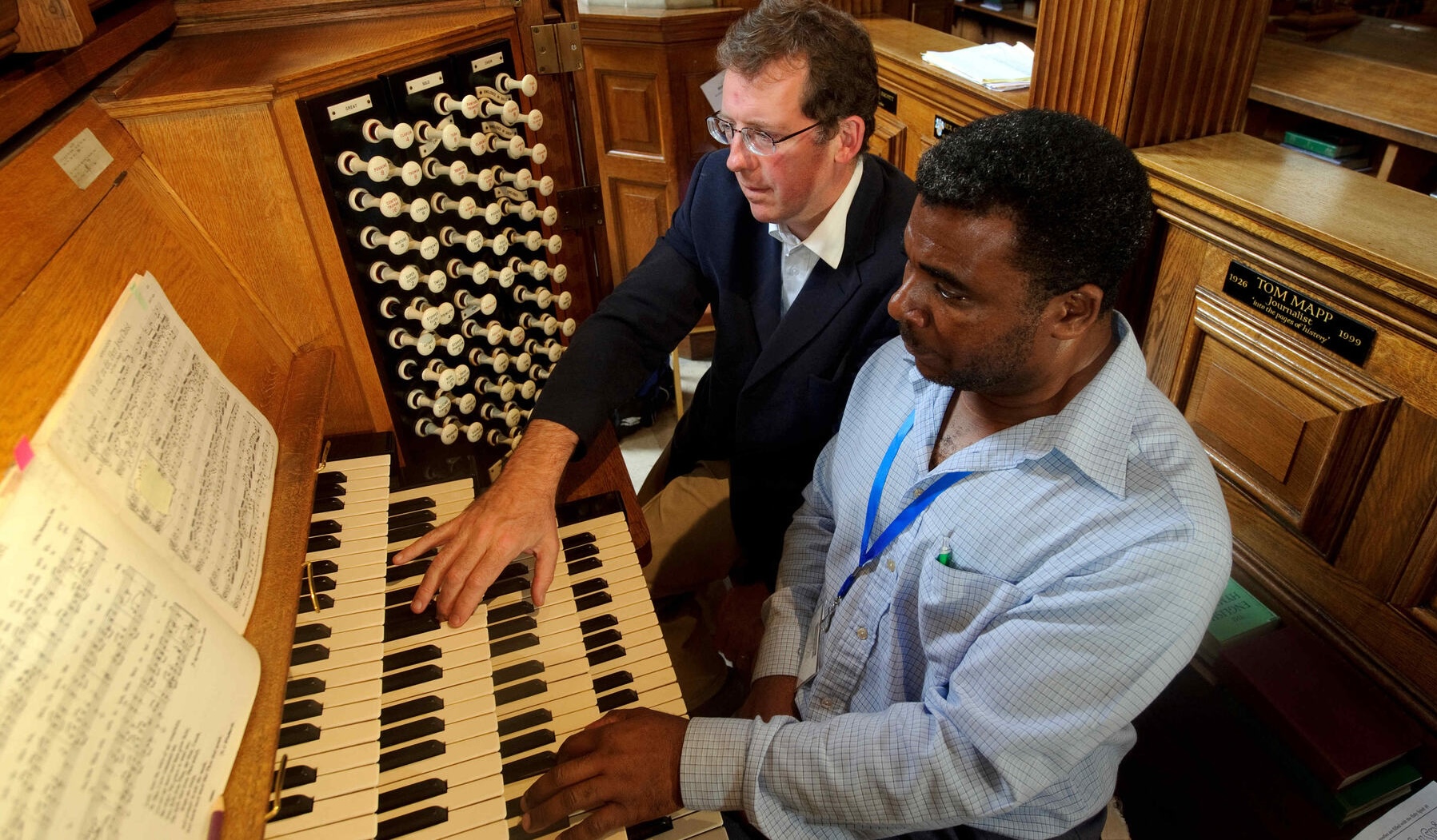
RCO Accreditation provides a structured and respected framework that teachers, mentors and institutions can recommend with confidence.
Whether working in churches, schools, universities, conservatoires or independent practice, teachers and mentors play a vital role in guiding students towards appropriate benchmarks, nurturing musical development and broadening artistic horizons. This page outlines how RCO qualifications can support that work.
RCO qualifications offer more than an examination outcome. They provide a structured stimulus for musical growth, independent learning and sustained artistic development.
RCO awards are granted by a chartered institution with a long-standing commitment to musical standards in organ performance and choral direction. They represent externally moderated recognition beyond internal school assessment.
From CAM through to Fellowship, the framework offers defined stages of development. This helps students and teachers set realistic, motivating goals within a coherent long-term pathway.
The diplomas encourage disciplined preparation, independent research, critical listening and contextual understanding. Students learn not only to perform or direct, but to think about their practice.
The qualifications promote:
They encourage a holistic view of musicianship rather than narrow repertoire preparation.
Preparation for ARCO and FRCO in particular fosters:
These are valuable skills for students progressing to university — whether in music or other disciplines.
For students not intending to pursue music at degree level, RCO diplomas offer a meaningful and respected benchmark of attainment outside the framework of GCSE/A Level or graded examinations.
Candidates become part of a national and international community of diploma holders and peers working in diverse contexts. This broadens horizons beyond the confines of school or local examination systems.
Institutions that recommend and support RCO qualifications may find benefits in several areas.
Institutions are also encouraged to explore formal recognition through the RCO Accredited Institution scheme, further strengthening partnership and collaboration with the College.
RCO qualifications are not intended to replace existing syllabuses. They can complement and extend them.
Examples include:
Rather than mapping mechanically onto other qualifications, RCO awards are best understood as parallel benchmarks that strengthen and deepen existing study. They provide external validation and a broader framework for development.
“CAM was my first major milestone or achievement as an organist, and I think that it has set me up very well for ARCO and Grade 7–8 organ music. — Asael Kazibwe (UK)
Teachers may find it helpful to think in terms of staged development:
In choral directing, a comparable progression can be identified:
Progression between levels will vary depending on the individual candidate. There is no fixed timetable. Musical maturity, breadth of repertoire, technical fluency, rehearsal leadership skills and written or reflective confidence all play a role in determining readiness for the next stage.
Most candidates select an appropriate level. However, the diplomas are demanding, and part of good preparation involves honest appraisal.
Teachers can support candidates by:
Ambition should be encouraged, but grounded in careful and realistic preparation. A well-timed entry often leads to a more confident and successful outcome.
Teachers should encourage specific consideration and reflection with regards to progression from ARCO to FRCO, which should be understood as a period of consolidation and deepening artistic maturity rather than a rapid step to a higher examination.
While some candidates may move relatively quickly between the two levels, for many the transition represents a significant broadening of repertoire, interpretative authority and technical assurance. Fellowship requires not only accuracy and security, but a distinctive and compelling musical voice.
Teachers may wish to consider:
A strong ARCO performance often indicates proximity to Fellowship standard, but readiness for FRCO is as much about musical maturity as examination technique. Allowing time for development between the two levels can result in a more secure and successful outcome.
Ambition should be encouraged, but grounded in thoughtful preparation and honest appraisal of the published descriptors.
When considering the suitability and practicality of examination entry for students, teachers may also consider:
Each diploma descriptor can serve as a concise learning plan, helping teachers and students understand not only what is examined, but what is being developed. Preparation can be supported through:
“I had a very good experience preparing for CAM. The repertoire was accessible for those who are newer to the organ and it tests foundational skills – like accompaniment and ability to analyse a piece of music – which are fundamental for someone who wants to become an organist.”— Asael Kazibwe (UK)
Teachers and institutions recommending RCO qualifications need clarity, transparency and accessible support. The following information outlines the practical framework available to support preparation and informed decision-making.
Full regulations are published for each qualification, setting out:
The published level descriptors — for example, CRCO as “a standard of reliable and confident musicianship in public performance” — provide particularly helpful benchmarks. These descriptors can be used as concise reference points when discussing readiness and progression with students.
Teachers are encouraged to review these documents carefully with prospective candidates, ensuring expectations are understood before entry.
RCO examinations operate on clearly defined entry cycles, with published deadlines and assessment windows.
Assessment formats include:
The availability of audio-visual submission enables participation from international and distance candidates, offering flexibility while maintaining consistent standards.
RCO qualifications are most effective when positioned as part of a broader developmental pathway rather than as isolated examination goals.
Teachers may choose, for example, to:
Progression timelines will vary according to individual development and context.
Preparation for RCO qualifications is supported by a range of resources, including:
These structures are designed to complement existing teaching rather than replace it. Teachers remain central to preparation, with RCO resources providing additional reinforcement and perspective.
The Royal College of Organists is committed to making accreditation as accessible as possible, regardless of age, background or location.
Where location or ability to travel for the performance section of practical examinations is an issue (especially for overseas candidates), exceptions are available. Where an exception has been applied for and granted in advance, this section may be completed through audio-visual submission. See the individual examination regulations for more details.
Where the cost of preparing for and taking an examination could be a barrier, the College is able to consider applications to its awards and bursaries scheme for assistance. Typically, the awards and bursaries can contribute to lessening the burden of course, tuition and examination fees, and help with the building of relevant resources.
Awards are made possible through the generosity of benefactors and are available across a wide range of ages and stages, with many open to both students and adult learners.
In addition, the College highlights and signposts external scholarships and funding opportunities where relevant.
Explore funding opportunities >>
RCO Accreditation is intended to function as a partnership between the College, teachers and candidates — supporting musical growth through structured challenge and recognised achievement.
If you require information or guidances that is not on these resource pages or within the examination regulations or other documents, teachers and institutions are welcome to contact the College to discuss:
Contact the RCO Accreditation team on accreditation@rco.org.uk